Dalits Abroad

Caste systems in Africa

Caste systems in Africa refer to forms of social stratification based on hereditary, endogamous (marriage within the group) groups tied to specific occupations, often with concepts of ritual pollution or impurity that limit social interactions like shared meals (commensality). These are found in numerous ethnic groups across more than 15 countries, especially in the Sahel and West Africa, but also in parts of East and North Africa. They differ from the Indian caste system in origins, religious basis (often not tied to Hinduism), and structure—African versions are typically less pan-societal and more focused on artisan/musician groups alongside noble, freeborn, and slave-descended strata.

Key Features of African Caste Systems

  • Hereditary and Endogamous: Membership is by birth; marriage outside the caste is traditionally taboo or rare.
  • Occupational Specialization: Lower or "casted" groups often handle crafts like blacksmithing, leatherworking, pottery, weaving, or roles as bards/griots (praise-singers and historians).
  • Hierarchy with Ambivalence: "Casted" people may be respected for their skills (e.g., blacksmiths linked to spiritual power or fire) but stigmatized as "impure" due to myths of ancestral transgressions or polluting work.
  • Social Restrictions: Limits on land ownership, political roles, burial practices, and participation in initiation societies or cultural events. Some systems include embedded slavery or slave descendants.
  • Scale: These are usually pockets within ethnic groups (e.g., 10-30% of the population in affected societies), not a rigid all-encompassing system like varna in classical India. Estimates suggest they affect tens of millions, particularly in West Africa.

Caste-like discrimination persists in modern times despite legal abolitions in some countries, affecting employment, marriage, education, and political representation. Urbanization, Islam/Christianity, and modernization have weakened but not eliminated them—endogamy and subtle stigma often continue.

West Africa (Most Prominent Region)

Caste systems are well-documented among Mande-speaking peoples (Mali, Senegal, Guinea, etc.) and others like Wolof, Soninke, Fulani, Songhay, and Tuareg. They likely developed between the 9th-15th centuries, possibly linked to empire-building, slavery, and craft specialization.

Common structure (varies by group):

  • Nobles/Freeborn (e.g., horon or garmi among Wolof/Mande): Highest status, warriors, rulers, or farmers.
  • Occupational Castes (nyamakala or niégno): Artisans and specialists.
    • Blacksmiths (numu): Metalworkers, often revered yet feared for mastery of fire/sorcery; endogamous and sometimes linguistically distinct.
    • Griots/Jeli (bards/musicians): Oral historians, praise-singers; ambivalent status—powerful through words but socially separate.
    • Leatherworkers, potters, weavers, etc.
  • Slave Descendants (diaam or similar): Lowest, with ongoing marginalization.

Examples:

  • Wolof (Senegal): Nobles, peasants (geer), occupational castes, and slave descendants. Stigma includes beliefs that contact with certain castes causes physical issues (e.g., pimples).
  • Tuareg (Mali, Niger, Burkina Faso): Includes artisan castes (blacksmiths) and Bellah (slave caste) facing servitude-like conditions.
  • Discrimination: Housing segregation, refusal of intermarriage, exclusion from leadership. Surveys show persistent effects on social tolerance and support for government intervention.

These systems affect an estimated 90 million people across at least 15 ethnic groups in the region.

East and Horn of Africa

  • Somalia: "Sab" (low-caste) groups (blacksmiths, leatherworkers, hunters) face pollution myths, denial of land/cattle ownership, no diya (blood money) rights, and enforced endogamy. Patron-client relationships with dominant clans persist, even in diaspora.
  • Ethiopia: Among Amhara and southern groups, occupational castes (tanners, potters, weavers) and slave-like strata exist with similar pollution concepts and restrictions. Marginalized groups like Manja face daily exclusion.
  • Other: Limited reports in parts of Kenya or among certain groups.

Other Regions

  • Madagascar: Highly stratified among Merina people, with slave castes (andevo) facing severe ongoing discrimination and exploitation despite historical abolition. UN reports highlight this as descent-based marginalization.
  • Nigeria: The Osu system among Igbo involves ritual dedication leading to segregation, endogamy taboos, and violence against integration attempts.
  • Mauritania and Sahel: Haratin (former slave descendants) and artisan castes endure economic and social exclusion; slavery-like practices persist in isolated areas.

Indian Diaspora and Caste in Africa

In countries with significant Indian communities (e.g., South Africa, East Africa like Kenya/Tanzania/Uganda, Mauritius), elements of the South Asian caste system were imported via indentured labor and trade migration (19th-20th centuries). Upper-caste Indians sometimes reproduced hierarchies, viewing local Africans through a caste-like lens (e.g., derogatory terms or social distance in homes). However, colonial racial categories and anti-apartheid struggles often blurred or compromised strict caste practices. Many South African Indians today report that traditional caste (Brahmin/Kshatriya etc.) is weak or irrelevant in daily life and marriage, though endogamy within broader cultural/linguistic groups persists in some families. Dalit-like consciousness or discrimination within the diaspora is less documented but exists in pockets.

Comparison to Indian SC/ST Contexts

African systems share traits with South Asian ones (endogamy, heredity, pollution, occupational links, discrimination against "low" groups) but lack a unified religious sanction like varna/jati or legal recognition akin to India's SC/ST reservations. African "casted" groups are often skilled artisans rather than purely landless laborers, and mobility has increased more through Islam, Christianity, education, and urbanization. Stigma attaches to descent-based groups (including slave descendants), leading to similar issues of social exclusion as faced by disadvantaged communities elsewhere. International bodies like the UN and Dalit Solidarity Network note parallels in descent-based discrimination.

These practices are declining in urban, educated, or migrant contexts but remain resilient in rural or traditional settings, reinforced by family names, myths, and social pressure. Many affected individuals advocate for greater awareness and integration.

Balinese caste system

The Balinese caste system (locally known as Catur Wangsa or Catur Warna, meaning "four lineages" or "four colors") is a traditional social classification among the Hindu population of Bali, Indonesia. It draws from ancient Hindu concepts (similar to India's varna system) but has evolved distinctly due to local history, culture, and Balinese Hinduism (Agama Hindu Dharma).

The Four Main Castes (Wangsa)

Balinese society is traditionally divided into four broad groups, ranked from highest to lowest in ritual and social status:

  1. Brahmana (Brahmin) — Highest caste
    • Traditionally priests, scholars, and spiritual leaders.
    • They officiate major religious rituals (pedanda high priests come from this group).
    • Common name prefixes: Men — Ida Bagus; Women — Ida Ayu (or Dayu).
    • Symbolized by the color white.
  2. Ksatria (Kshatriya or Satria) — Warrior/noble caste
    • Historically associated with rulers, kings, warriors, nobles, and administrators. Many royal families (e.g., from the old Gelgel and Klungkung kingdoms) belong here.
    • Common titles: Anak AgungTjokorda (Cokorda), Dewa Agung, etc.
    • Symbolized by the color red.
  3. Wesya (Waisya or Wesia) — Merchant/trader caste
    • Linked to commerce, trade, artisans, and some administrative roles.
    • Common name prefixes: I GustiNgurahDewaSang, or Gusti Agung.
    • Symbolized by the color yellow.
  4. Sudra (Shudra) — Commoner or peasant caste
    • The largest group, comprising over 90–93% of the Balinese Hindu population.
    • Traditionally farmers, laborers, artisans, and village workers.
    • No aristocratic titles. Children are usually named by birth order:
      • 1st: Wayan or Putu
      • 2nd: Made or Kadek
      • 3rd: Nyoman or Komang
      • 4th: Ketut
    • Symbolized by the color black.

The first three castes (Brahmana + Ksatria + Wesya) are collectively called Triwangsa (the "three peoples" or nobility/aristocrats). Sudra are sometimes referred to as Jaba ("outsiders" to the nobility).

Key Differences from the Indian Caste System

  • No Untouchables: Bali has no concept of Dalits or untouchables. Sudra are fully integrated into religious and village life.
  • Less Rigid: Caste in Bali is more about ritual status, naming, language use (higher castes traditionally use more respectful Balinese), and certain ceremonies. It never had the extreme occupational restrictions or pollution concepts seen in parts of India.
  • Fewer Sub-castes: Bali has a simpler structure with far fewer jati-like sub-divisions.
  • Social Mobility: Historically possible through merit, royal service, wealth, or religious achievement. In modern times, education, tourism, business, and government jobs have further blurred lines.
  • Village-Based Life: Daily social organization often revolves more around the banjar (village council) and subak (irrigation cooperative) than strict caste rules.

How It Affects Life in Bali

  • Names & Language: Caste is often visible in a person's full name and influences polite speech forms.
  • Marriage: Inter-caste marriage is possible but traditionally sensitive (especially a higher-caste woman marrying a lower-caste man, as the woman's status may "fall"). Many modern families are more flexible.
  • Religion & Rituals: Higher castes (especially Brahmana) have special roles in temple ceremonies, but everyone participates in village temples.
  • No Discrimination by Law: Indonesia's constitution and government prohibit caste-based discrimination. Bali's tourism-driven economy and modernization have reduced its daily importance.

Current Status (as of 2026)

The caste system still exists as part of cultural identity, especially in rural areas, family traditions, naming, and certain religious contexts. However, it has become much less influential in everyday life, education, business, politics, and urban settings due to:

  • Tourism and globalization
  • Modern education
  • Economic changes (wealthy Sudra families are common)
  • Younger generations prioritizing merit over birth

Many Balinese view it as a historical and ritual framework rather than a strict hierarchy. Prejudice or restrictions (e.g., in marriage) still occur in conservative families, but they are declining.

In summary, Bali's caste system is a milder, localized adaptation of Hindu varna ideas — more symbolic and ceremonial than oppressive. It shapes identity and some traditions but does not dominate modern Balinese life the way it once did.


Baekjeong

From Wikipedia, the free encyclopedia


Joseon caste systemClassHangulHanjaMeaning
Yangban 양반 兩班 aristocrats
Jung-in 중인 中人 middle people
Sangmin 상민 常民 commoners
Cheonmin 천민 賤民 vulgar commoners
Baekjeong 백정 白丁 untouchables
Nobi 노비 奴婢 slaves or serfs
VT


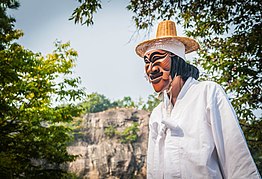
A masked person acting as a Baekjeong butcher in a play
Baekjeong
백정

The Baekjeong (Korean: 백정) were an "untouchable" minority group of Korea. In the early part of the Goryeo period (918–1392), these minority groups were largely settled in fixed communities. However, the Mongol invasion left Korea in disarray and anomie, and these groups became nomadic. Other subgroups of the baekjeong are the ‘chaein’ and the ‘hwachae’. During the Joseon dynasty, they were specific professions like basket weaving and performing executions. In the Goryeo period, baekjeong was used as a term to refer to the common people group. However, in Choson dynasty, it was refer to the lowest class of people and insulting title. In addition, in the Joseon Dynasty and today, the baekjeong was also used as an expression to denigrate a person. On the other hand, sometimes, the meaning is refined and used as a restaurant name. The fact that the name "Baekjeong" has changed into a term referring to various classes of people from different ages is a recent history research achievement.
Origin
There is a theory that they had migrated from Tartar. The term 'Tartar' seems to have been a general term for all northern peoples, Mongols, Manchurians, and so on. This theory is based on the writings of Jeong Yakyong, who was one of the most distinguished scholars on the methodology of historical researches in the reign of King Jeongjo (1777-1800) and King Sunjo (1801-1834). In his book, the origin of baekjeong is attributed to a nomadic group from the Goryeo period known as the Yangsuchuk (Hanja: 楊水尺) or Mujari (Korean: 무자리). Being an alien people from Tartar, the Yangsuchuk were hardly assimilated into the general population.[8] They were engaged in the making and selling of willow baskets. They were also proficient in slaughtering animals and had a liking for hunting, which was frowned upon by the Buddhist society of the Goryeo Dynasty.

History
In the Goryeo period

From the Goryeo Dynasty(918~1392) until the time of King Sejong of the Joseon Dynasty, baekjeong was not a title to refer to the lowest class of people.The term baekjeong itself means "common people. The scholars assume that the baekjeong is "a person who have no burden of duties(역, 役)" based on "Goryosa". It consists of "baek"(Korean: 백, Hanja: 白), which means 'white/innocent/blank', and "jeong(Korean: 정, Hanja: 丁)", or "person, man". As such, baekjeong, "blank man," connotes a group of peasants who have not been granted land because they have not received certain duties from the state.
But they also existed as the lowest class of people. In the Goryeo period, the names calling them were 'yangsuchuk(hanja: 楊水尺)', 'suchuk(hanja: 水尺)', 'hawchuck(hanja: 禾尺)' and 'mujari(Korean: 무자리, lit. "placeless")'. They had been a descendant of the Jurchen or Khitans since the beginning of Koryo. These lowest worship groups liked the group life among themselves, so they continued to live in a temporary residence while moving to various areas. they were distributed nationwide, especially in Pyeongan-do and Hwanghae-do provinces. They were not registered in the national register.
In the Joseon period


After the Goryeo period, Joseon was founded. In the early days of the founding of the Joseon Dynasty, King Sejong consolidated 'yangsucheok', 'sucheok', 'hawcheok' and 'mujari' with ordinary farmers. Therefore, the title calling them became 'Baekjeong', which is the general peasant group in the Goryeo period. King Sejong also put them on the family register, gave them lands to plant and settled them into farmers, and tried to keep them under state control. However, the common policies of King Sejong could not succeed because the ordinary people continued to do so and discriminated against it. Even government officials did not follow the instructions of the king.
On the other hand, it seems that the baekjeong did not change their existing lifestyle or occupation easily. They settled in one area and did not try to farm, but they lived and worked in certain jobs, such as making and selling wicker products, slaughtering, singing and dancing. In this situation, the exchange and integration with the baekjeong and the ordinary peasants was not easy, and the practice of discrimination and suppression against the white cane continued.In particular, the mainstream group regarded the life and customs of the butchers as despicable, antisocial, non-normative, and even potential criminal groups.
End of the Joseon Dynasty


Near the end of the Joseon Dynasty, a mutual aid organization for the baekjeong was established, called Seungdongdoga(Korean: 승동도가, hanja: 承洞都家), with representatives from various communities. The organization was involved in taking actions, coordinating improvements, and acting at times as the official representative of the baekjeong in legal matters. In 1894, the system of cadets was legally abolished by the Gopal reform. However, social discrimination against the baekjeong was not lost. The family register of baekjeong was still separate, and it was marked by the use of the word "殺漢(killing the beast)" or the red dot. Nonetheless, the Gapo reform ensured that baekjeong could become an official, an asset, a scholar or an artist if they had the ability.[ Although still largely limited to their traditional occupations, modified regulations in 1896 allowed non-baekjeong to become licensed butchers, eventually leading to meat businesses which have pressured many out of one of the few tasks allowed them.
However, while changes to improve the baekjeong's social status was slow, commoners (the lower of the yangmins), who had economically been little different from slaves, was already meaningless as the respect for the government in the 17th century as they fled from the invading Japanese and Manchurians, leaving the civilians at their mercy. The government also awarded many militiamen yangban class status in exchange for their voluntary militia activities against these invaders. In time, with the rise of commerce, merchants bought forged family histories and official status documents as well. Eventually, around three fourths of the population were yangban in name.
Modern

The term "baekjeong" still remains in modern Korean society. This is particularly common in occupations dealing with raw meat. When someone choose a job to deal with raw meat, they sometimes encounter severe objections. But at the same time, there is also a restaurant that uses the word "baekjeong". This is also an example of the fact that the butcher is not used as a word to disparage others.
Jobs
Executioner

Throughout much of the Joseon Dynasty, they were also forced to serve as executioners. When the baekjeong community were called upon to supply an executioner, the job was assigned to some hapless member, sometimes practically an insane person.
Butcher

The baekjeong did jobs that no self-respecting Buddhist Korean would touch, including anything working with animals. Slaughtering animals; leather making; these kinds of dirty duties were avoided by Koreans, and so were filled de facto by baekjeong. In other words, the group was assigned to the most demeaning tasks in Korean society. They were also considered in moral violation of Buddhist principles, which led Koreans to see work involving meat as polluting and sinful, even if they saw the consumption as acceptable. By the latter part of the Joseon Dynasty, baekjeong accepted the principles of Confucianism and did not slaughter for three years when their parents died.
Discrimination

The group had long suffered severe social discrimination in Korean society. The baekjeong were seen as contemptible and polluted people that others feared and avoided meeting. Baekjeong could not live in a Roof tiles house, did not wear silk clothes, did not wear leather shoes, and did not wear a gat(hat). When baekjeong went outside their houses, they had to untie their head and wear paeraengi. Baekjeong had to lower himself in front of a yangin. Baekjeong could not smoke or drink in front of a yangin. Baekjeong could not ride a litter or horse when they married, and a married woman could not wear a hair stick. Baekjeong could not put a last name on their name, nor could they use words in their name like 仁, 義, 禮, 智(Korean: 인, 의, 예, 지). The extent to which they were seen as polluted people is well-illustrated in the fact that their bodies were kept in separate graveyards so as not to mingle with those of the yangmin.
Influence of religion

Donghak and Christianity had a lot of influence on the Baekjeong. Both Donghak and Christianity exposed the Baekjeong, and Koreans more generally, to concepts of egalitarianism and social equality. The influence of these religions was then linked to the social movement.
Donghak

Towards the end of the 19th century, there was an increasing impetus on human dignity and liberalization. Of particular importance was the growth of certain religions(Donghak) supportive of change. Donghak, a Korean nationalist religion, wished to end unfair sinbun conventions, and Tonghak peasants had staged an uprising in 1894 in favor of human rights, especially for those low on the social ladder. They also demanded that the baekjeong no longer be forced to wear discriminatory hats and widows be allowed to remarry. Although this uprising was ultimately unsuccessful, it was an important impetus behind the Gabo Reform, and helped to abolish the status structure that had restricted some groups legally. However, the baekjeong had benefited much less from these changes than other groups, such as the slaves.
Christianity

The other major religious influence on human rights came through Christianity. Some missionaries had converted baekjeong to Christianity, stating that everyone has equal rights under God. However, everyone was not equal under the Christian congregation, and protests erupted when missionaries attempted to integrate them into worship services, with non-baekjeong finding such attempts insensitive to traditional notions of social status. Thus, both Donghak and Christianity exposed the baekjeong, and Koreans more generally, to concepts of egalitarianism and social equality. Parallel to and supportive of the rise of these ideas were transitions occurring in Korean society as a whole, particularly with regard to social classes.
Social movements

Beginning in the late 19th and early 20th centuries, the baekjeong began to resist the open social discrimination that existed against them. In 1900, leaders from 16 counties petitioned the mayor of Jinju to wear the same clothes and hats as other people. When others in the north refused to wear the humiliating garb traditionally expected of them and were jailed, an effort was made to release them. Growing industrialism in Korea began to erode baekjeong dominance over certain occupations, particularly as the Japanese began to control slaughterhouses and exploit them as employees.
However, as some baekjeong fell into financial despair, the loosening of segregation led others to profit from changes, giving them the ability to fund efforts for change. Beyond financial resources, organization was also strengthened due to the longstanding connections created through segregation and close-knit social networks. Between these human and financial resources, an emphasis on progressive models, and feelings of social deprivation and discrimination, the conditions were ripe for the baekjeong to mobilize for change. One of the earliest of these movements was in 1910 when Chang Chip'il, later an influential member of the Hyeongpyeongsa, attempted to unsuccessfully establish a trade union for butchers. In 1921, the Jipseong Johap was established by Korean and Japanese entrepreneurs, attempting to provide poverty assistance for butchers. However, this effort for improvement of economic conditions was soon overshadowed by an organization with broader goals.
The Hyeongpyeongsa was launched in Jinju on 23 April 1923 through the alliance of wealthy or educated baekjeong and non-baekjeong proponents of change, advocating for "the abolition of classes and of contemptuous appellations, the enlightenment of members, and the promotion of mutual friendship among members." It advocated both for individual civil rights as well as communal fellowship, recognizing that the group must maintain its identity under the strain of changes such as urbanization and industrialization which threatened to atomize the community. Thus, the Hyeongpyeongsa pursued both an equality of human rights and the right to assimilate into the broader public, even as it worked to forge a common identity. In 1927 a number of members of the Hyeongpyeongsa were arrested for their involvement in the creation of an underground nationalist organization. Their absence was partially responsible for the organization's shift to the socialist left in the late 1920s. Power within the organization shifted several times, including the shift in 1925 from the original Chinju faction advocating educational reform to a group of Seoul intellectuals more interested in economic reforms based around traditional occupations.
At the 1931 national conference, they stirred controversy within the movement by introducing a dissolution proposal, feeling that the organization had abandoned its original aims in favor of those of the bourgeois intellectuals directing it. It was their belief that dissolution would better serve their interests as it was replaced by trade unions. The dissolution proposal failed, but not without further alienating more conservative members of the movement, who were already financially strapped from broader economic conditions in Korea. Even more fatal for the movement was the arrest of a number of young radical members, who were accused of establishing a secret communist organization, the "Hyeongpyeongsa Youth Vanguard", which authorities said demanded struggle against feudalism and the abolishment of private property. The trial related to this accusation dragged on for four years, before the defendants were found to be innocent. It appears likely that the "organization" was a construction by Japanese authorities to ensure the labor wing of the Hyeongpyeongsa would not interfere with their access to leather needed for the invasion of China. As a result, the Hyeongpyeongsa shifted to the right, abandoning progressive ideals and finally disbanding in 1935, claiming the movement's aims had successfully been met.
The growing power of the radical wing divided the movement, and much of the economic support provided by wealthier baekjeong was pulled, particularly under the strain of the Great Depression, which had negatively impacted the meat and leather trades. The young socialists in the Hyŏngp'yŏngsa forged connections with other movements, attempting to broaden the movement and work towards "the reconstitution of Korea as a whole." More importantly, they focused on social and economic injustices affecting the baekjeong, hoping to create an egalitarian Korean society. Their efforts included attacking social discrimination by the upper class, authorities, and "commoners" and the use of degrading language against children in public schools.

Tanka people
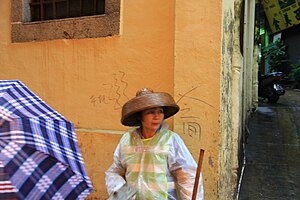
Tanka woman in Macau.
Languages
for those living in the diaspora speak English, Vietnamese, Khmer, Tetun, Burmese, Thai, Hindi, Bengali, Malay (both Malaysian/Bruneian and Indonesian), Spanish, Portuguese (including Macau), French, Fijian, Creole and Dutch
Religion

Tanka people
Chinese 1. 蜑家/疍家
2. 艇家
3. 水上人
4. 曲蹄
5. 蜑民
6. 曲蹄囝
Literal meaning 1. Dàn (egg/vermin/..., used only as proper noun in Modern Chinese) families
2. boat households
3. people on water
4. crooked hoof, bowlegged
5. Dàn people
6. crooked hoof children; bowlegged children

showTranscriptions

Tankas (simplified Chinese: 家; traditional Chinese: 家; pinyin: Dànjiā; Cantonese Yale: Daahngā) or boat people are a sinicized ethnic group in Southern China[3] who have traditionally lived on junks in coastal parts of Guangdong, Guangxi, Fujian, Hainan, Shanghai, Zhejiang and along the Yangtze river, as well as Hong Kong, and Macau. The Boat people are referred to with other different names outside of Guangdong (not called Tanka). Though many now live onshore, some from the older generations still live on their boats and pursue their traditional livelihood of fishing. Historically, the Tankas were considered to be outcasts. Since they were boat people who lived by the sea, they were sometimes referred to as "sea gypsies" by both Chinese and British. Tanka origins can be traced back to the native ethnic minorities of southern China known historically as the Baiyue who may have taken refuge on the sea and gradually assimilated into Han culture. However, Tanka have preserved many of their native traditions that are not found in Han Chinese culture.
A small number of Tankas also live in parts of Vietnam. There they are called Dan (Đàn) and are classified as a subgroup of the Ngái ethnicity.
Etymology
The term Tanka is now considered derogatory and no longer in common use. "Tank" is a Cantonese term for boat or junk and "ka" means family or peoples. These boat dwellers are now referred to in China as "on-water people" (Chinese: 水上人; pinyin: shuǐshàng rén; Cantonese Yale: Séuiseuhngyàn), or "people of the southern sea" (Chinese: 南海人; Cantonese Yale: Nàamhóiyàn). No standardised English translation of this term exists. "Boat People" is a commonly used translation, although it may be confused with the similar term for Vietnamese refugees in Hong Kong. The term "Boat Dwellers" was proposed by Dr. Lee Ho Yin of The University of Hong Kong in 1999, and it has been adopted by the Hong Kong Museum of History for its permanent exhibition.
Both the Tanka and the Cantonese speak the Cantonese language. However, Tanka living in Fujian speak Min Chinese.
"Boat people" was a general term for the Tanka. The name Tanka was used only by Cantonese to describe the Tanka of the pearl river delta.
The Tanka Boat people of the Yangtze region were called the Nine surnames fishermen households, while Tanka families living on land were called the Mean households.
There were two distinct categories of people based on their way of life, and they were further divided into different groups. The Hakka and Cantonese lived on land; the Tanka (including Hokkien-speaking Tanka immigrants often mistaken for being Hoklo) lived on boats and were both classified as boat people.
The differences between the sea dwelling Tanka and land dwellers were not based merely on their way of life. Cantonese and Hakka who lived on land fished sometimes for a living, but these land fishermen never mixed or married with the Tanka fishermen. Tanka were barred from Cantonese and Hakka celebrations.
British reports on Hong Kong described the Tanka including Hoklo-speaking Tanka boat people living in Hong Kong "since time unknown". The encyclopaedia Americana alleged that Tanka living in Hong Kong "since prehistoric times".
Geographic Distribution
The Tanka people are found throughout the coasts and rivers of the following regions:
Zhejiang: Zhoushan Archipelago, Taizhou Bay, Wenzhou Bay, Sanmen Bay, Hangzhou Bay, Xin'an River, Fuchun River, Lanjiang River
Fujian: Min River Mouth, Fuqing Bay, Xinghua Bay, Quanzhou Bay, Amoy Bay, Zhangzhou Water Front
Guangdong: Jieshi Bay, Honghai Bay, Daya Bay, Dapeng Bay, Zhujiang River Mouth, Leizhou Bay, Lingding Sea, Zhanjiang, Wanshan Archipelago
Guangxi: You River
Anhui: Xin'an River
Jiangxi: Gan River
Beijing, Jiangsu, Henan, Hubei, Hunan: Grand Canal
Shanghai: city river
Hong Kong: Kowloon
Macau: Macau Bay
Origin
Mythical origins
Some Chinese myths claim that animals were the ancestors of the Barbarians, including the Tanka people. Some ancient Chinese sources claimed that water snakes were the ancestors of the Tanka, saying that they could last for three days in the water, without breathing air.
Baiyue connection and origins in Southern China

The Tanka are considered by some scholars to be related to other minority peoples of southern China, such as the Yao and Li people (Miao). The Amoy University anthropologist Ling Hui-hsiang wrote on his theory of the Fujian Tanka being descendants of the Bai Yue. He claimed that Guangdong and Fujian Tanka are definitely descended from the old Bai Yue peoples, and that they may have been ancestors of the Malay race. The Tanka inherited their lifestyle and culture from the original Yue peoples who inhabited Hong Kong during the Neolithic era. After the First Emperor of China conquered Hong Kong, groups from northern and central China moved into the general area of Guangdong, including Hong Kong.
One theory proposes that the ancient Yue inhabitants of southern China are the ancestors of the modern Tanka boat people. The majority of western academics subscribe to this theory, and use Chinese historical sources. (The ancient Chinese used the term "Yue" to refer to all southern barbarians.) The Oxford English Dictionary, 2nd Edition, states that the ancestors of the Tanka were native people.
The Tanka's ancestors had been pushed to the southern coast by Chinese peasants who took over their land.
During the British colonial era in Hong Kong, the Tanka were considered a separate ethnic group from the Punti, Hakka, and Hoklo. Punti is another name for Cantonese (it means "local"), who came from mainly Guangdong districts. The Hakka and Hoklo are not considered as Puntis.
The Tanka have been compared to the She people by some historians, practising Han Chinese culture, while being an ethnic minority descended from natives of Southern China.
Yao connections

Chinese scholars and gazettes described the Tanka as a "Yao" tribe, with some other sources noting that "Tan" people lived at Lantau, and other sources saying "Yao" people lived there. As a result, they refused to obey the salt monopoly of the Song dynasty Chinese government. The county gazetteer of Sun on in 1729 described the Tanka as "Yao barbarians", and the Tanka were viewed as animals.
In modern times, the Tanka claim to be ordinary Chinese who happen to fish for a living, and the local dialect is used as their language.
Historiography
Some southern Chinese historic views of the Tanka were that they were a separate aboriginal ethnic group, "not Han Chinese at all". Chinese Imperial records also claim that the Tanka were descendants of aboriginals. Tanka were also called "sea gypsies". (from Chinese, 吉普赛人,(gypsies, Romani)).
The Tanka were regarded as Yueh and not Chinese, they were divided into three classifications, "the fish-Tan, the oyster-Tan, and the wood-Tan" in the 12th century, based on what they did for a living.
The three groups of Punti, Hakka, and Hoklo, all of whom spoke different Chinese dialects, despised and fought each other during the late Qing dynasty. However, they were all united in their overwhelming hatred for the Tanka, since the aboriginals of Southern China were the ancestors of the Tanka. The Cantonese Punti had displaced the Tanka aboriginals, after they began conquering southern China.
The Chinese poet Su Dongpo wrote a poem in which mentioned the Tanka.
The Nankai University of Tianjin published the Nankai social and economic quarterly, Volume 9 in 1936, and it referred to the Tanka as aboriginal descendants before Chinese assimilation. The scholar Jacques Gernet also wrote that the Tanka were aboriginals, who were known for being pirates, which hindered Qing dynasty attempts to assert control in Guangdong.
Scholarly opinions on Baiyue Austronesian connection
The most widely held theory is that the Tanka are the descendants of the native Yue inhabitants of Guangdong before the Han Cantonese moved in. The theory stated that originally the Yueh peoples inhabited the region, when the Chinese conquest began, either absorbed or expelled the Yue to southern regions. The Tanka, according to this theory, are descended from an outcast Yue tribe who preserved their separate culture.
Regarding the Fujian Minyue Tanka it is suggested that in the southeast coastal regions of China, there were many sea nomads during the Neolithic era and they may have spoken ancestral Austronesian languages, and were skilled seafarers. In fact, there is evidence that an Austronesian language was still spoken in Fujian as late as 620 AD. It is therefore believed that the Tanka were Austronesians who were more closely related to the Filipinos, Javanese or Balinese.
Before the invention of modern genetic testing, a minority of scholars who challenged this theory deny that the Tanka are descended from natives, instead claiming they are basically the same as other Han Cantonese who dwell on land, claiming that neither the land dwelling Han Cantonese nor the water dwelling Tanka have more aboriginal blood than the other, with the Tanka boat people being as Chinese and as Han as ordinary Cantonese.
Eugene Newton Anderson claimed that there was no evidence for any of the conjectures put forward by scholars on the Tanka's origins, citing Chen, who stated that "to what tribe or race they once belonged or were once akin to is still unknown".
Some researchers say the origin of the Tanka is multifaceted, with a portion of them having native Yueh ancestors and others originating from other sources.
History
Chinese colonisation and Sinicization
The Song dynasty engaged in extensive colonisation of the region with Chinese people.
Due to the extensive sinicisation of the Tanka, they now identify as Chinese, despite their non-Chinese ancestry from the natives of Southern China.
The Cantonese exploited the Tanka, using their own customs against them to acquire fish to sell from the Tanka.
In some inland regions, the Tanka accounted for half of the total population.
The Tanka of Quanzhou were registered as barbarian households.
Ming Dynasty
The Tanka boat population were not registered into the national census as they were of outcast status.
Macau and Portuguese rule

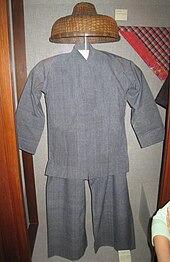
Traditional Tanka people clothes in a Hong Kong museum.
The Portuguese, who were granted Macau during the Ming dynasty, often married Tanka women since Han Chinese women would not have relations with them. Some of the Tanka's descendants became Macanese people.
Some Tanka children were enslaved by Portuguese raiders.
The Chinese poet Wu Li wrote a poem, which included a line about the Portuguese in Macau being supplied with fish by the Tanka.
When the Portuguese arrived at Macau, women from Goa (part of Portuguese India), Siam, Indochina, and Malaya became their wives, rarely were they Chinese women. The Tanka women were among the only people in China willing to mix and marry with the Portuguese, with other Chinese women refusing to do so.
The majority of marriages between Portuguese and natives was between Portuguese men and women of Tanka origin, who were considered the lowest class of people in China and had relations with Portuguese settlers and sailors, or low class Chinese women. Western men like the Portuguese were refused by high class Chinese women, who did not marry foreigners.
Literature in Macau was written about love affairs and marriage between the Tanka women and Portuguese men, like "A-Chan, A Tancareira", by Henrique de Senna Fernandes.
Qing dynasty

Tanka. Tankia (tan'ka, tan'kyä), n. [Chinese, literally, 'the Tan family or tribe'; < Tan, an aboriginal tribe who formerly occupied the region lying to the south and west of the Meiing (mountains) in southern China, + kia (pronounced ka in Canton), family, people.] The boat population of Canton in southern China, the descendants of an aboriginal tribe named Tan, who were driven by the advance of Chinese civilisation to live in boats upon the river, and who have for centuries been forbidden to live on the land. "Since 1730 they have been permitted to settle in villages in the immediate neighbourhood of the river, but are still excluded from competition for official honours, and are forbidden by custom from intermarrying with the rest of the people. (Q&es, Glossary of Reference.)
Attempts were made to free the Tanka and several other "mean" groups from this status in a series of edicts from 1723 to 1731. They mostly worked as fishermen and tended to gather at some bays. Some built markets or villages on the shore, while others continued to live on their junks or boats. They claimed to be Han Chinese.
The Qing edict said "Cantonese people regard the Dan households as being of the mean class (beijian zhi) and do not allow them to settle on shore. The Dan households, for their part, dare not struggle with the common people", this edict was issued in 1729.
As Hong Kong developed, some of the fishing grounds in Hong Kong became badly polluted or were reclaimed, and so became land. Those Tankas who only own small boats and cannot fish far out to sea are forced to stay inshore in bays, gathering together like floating villages.
Lifestyle and culture

Always there is plenty to see, as the Tanka. the people who live in the boats, are full of life. They are an aboriginal tribe, speaking an altogether different language from the Chinese. On the land they are like fish out of water. They are said never to intermarry with landlubbers, but somehow or other their tongue has crept into many villages in the Chiklung section. The Chinese say the Tanka speech sounds like that of the Americans. It seems to have no tones. A hardy race, the Tanka are untouched by the epidemics that visit our coast, perhaps because they live so much off land. Each family has a boat, its own little kingdom, and, there being plenty of fish, all look better fed than most of our land neighbours. Christianity is, with a few rare exceptions, unknown to them. The only window of our Chiklung house gives the missioner a full view of the village life of some of the boat tribe. The window at present is just the absence of the south wall of the little loft to the shop. Wooden bars can be inserted in holes against robbers.
Catholic Foreign Mission Society of America in 1921
Before leaving the market, by special invitation we had a swim from off one of the sampans (a term used around Canton: here "baby boat" is the name). The water was almost hot and the current surprisingly swift. Nevertheless the Tanka men and boys go in several times a day, and wash jacket and trousers, undressing and dressing in the water. They seem to let the clothes dry on them. Women and girls also jump in daily.
Catholic Foreign Mission Society of America in 1921
Masonry was unknown by the water dwelling Tanka.
Canton (Guangzhou)
The Tanka also formed a class of prostitutes in Canton, operating the boats in Canton's Pearl River which functioned as brothels, they did not practice foot binding and their dialect was unique. They were forbidden to marry land dwelling Chinese or live on land. Their ancestors were the natives of Southern China before the Cantonese expelled them to their current home on the water.
Modern China
During the intensive reclamation efforts around the islands of Shanghai in the late 1960s, many Tanka were settled on Hengsha Island and organised as fishing brigades.
British occupation of Hong Kong

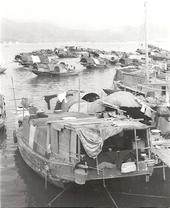
Hong Kong boat dwellings in December 1970.
In 1937, Walter Schofield, then a Cadet Officer in the Hong Kong Civil Service, wrote that at that time the Tankas were "boat-people [who sometimes lived] in boats hauled ashore, or in more or less boat-shaped huts, as at Shau Kei Wan and Tai O". They mainly lived at the harbours at Cheung Chau, Aberdeen, Tai O, Po Toi, Kau Sai Chau and Yau Ma Tei.
Elizabeth Wheeler Andrew (1845–1917) and Katharine Caroline Bushnell (5 February 1856 – January 26, 1946), who wrote extensively on the position of women in the British Empire, wrote about the Tanka inhabitants of Hong Kong and their position in the prostitution industry, catering towards foreign sailors. The Tanka did not marry with the Chinese, being descendants of the natives, they were restricted to the waterways. They supplied their women as prostitutes to British sailors and assisted the British in their military actions around Hong Kong The Tanka in Hong Kong were considered "outcasts" categorised low class.
Ordinary Chinese prostitutes were afraid of serving Westerners since they looked strange to them, while the Tanka prostitutes freely mingled with western men The Tanka assisted the Europeans with supplies and providing them with prostitutes. Low class European men in Hong Kong easily formed relations with the Tanka prostitutes. The profession of prostitution among the Tanka women led to them being hated by the Chinese both because they had sex with westerners and them being racially Tanka.
The Tanka prostitutes were considered to be "low class", greedy for money, arrogant, and treating clients with a bad attitude, they were known for punching their clients or mocking them by calling them names. Though the Tanka prostitutes were considered low class, their brothels were still remarkably well kept and tidy. A famous fictional story which was written in the 1800s depicted western items decorating the rooms of Tanka prostitutes.
The stereotype among most Chinese in Canton that all Tanka women were prostitutes was common, leading the government during the Republican era to accidentally inflate the number of prostitutes when counting, due to all Tanka women being included. The Tanka women were viewed as such that their prostitution activities were considered part of the normal bustle of a commercial trading city. Sometimes the lowly regarded Tanka prostitutes managed to elevate themselves into higher forms of prostitution.
Tanka women were ostracised from the Cantonese community, and were nicknamed "salt water girls" (ham sui mui in Cantonese) for their services as prostitutes to foreigners in Hong Kong.
Tanka women who worked as prostitutes for foreigners also commonly kept a "nursery" of Tanka girls specifically for exporting them for prostitution work to overseas Chinese communities such as in Australia or America, or to serve as a Chinese or foreigner's concubine.
A report called "Correspondence respecting the alleged existence of Chinese slavery in Hong Kong: presented to both Houses of Parliament by Command of Her Majesty" was presented to the English Parliament in 1882 concerning the existence of slavery in Hong Kong, of which many were Tanka girls serving as prostitutes or mistresses to westerners.
Correspondence respecting the alleged existence of Chinese slavery in Hong Kong: presented to both Houses of Parliament by Command of Her Majesty in 1882
Ernest John Eitel claimed that all "half caste" people in Hong Kong were descended exclusively from Europeans having relationship with Tanka women, and not Chinese women. The theory that most of the Eurasian mixed race Hong Kong people are descended only from Tanka women and European men, and not ordinary Cantonese women, is backed up by other researchers who pointed out that Tanka women freely consorted with foreigners due to the fact that they were not bound by the same Confucian traditions as the Cantonese, and having a relationship with European men was advantageous for Tanka women. The ordinary Cantonese women did not sleep with European men, the Eurasian population was formed only from Tanka and European admixture.
The day labourers settled down in huts at Taipingshan, at Saiyingpun and at Tsimshatsui. But the largest proportion of the Chinese population were the so-called Tanka or boat people, the pariahs of South-China, whose intimate connection with the social life of the foreign merchants in the Canton factories used to call forth an annual proclamation on the part of the Cantonese Authorities warning foreigners against the demoralising influences of these people. These Tan-ka people, forbidden by Chinese law (since A.D. 1730) to settle on shore or to compete at literary examinations, and prohibited by custom from intermarrying with the rest of the people, were from the earliest days of the East India Company always the trusty allies of foreigners. They furnished pilots and supplies of provisions to British men-of war, troopships and mercantile vessels, at times when doing so was declared by the Chinese Government to be rank treason, unsparingly visited with capital punishment. They were the hangers-on of the foreign factories of Canton and of the British shipping at Lintin, Kamsingmoon, Tungkin and Hongkong Bay. They invaded Hongkong the moment the settlement was started, living at first on boats in the harbour with their numerous families, and gradually settling on shore. They have maintained ever since almost a monopoly of the supply of pilots and ships' crews, of the fish trade and the cattle trade, but unfortunately also of the trade in girls and women. Strange to say, when the settlement was first started, it was estimated that some 2,000 of these Tan-ka people had flocked to Hongkong, but at the present time they are about the same number, a tendency having set in among them to settle on shore rather than on the water and to disavow their Tan-ka extraction to mix on equal terms with the mass of the Chinese community. The half-caste population in Hongkong were, from the earliest days of the settlement of the Colony and down to the present day, almost exclusively the off-spring of these Tan-ka people. But, like the Tan-ka people themselves, they are happily under the influence of a process of continuous re-absorption in the mass of the Chinese residents of the Colony.
During British rule some special schools were created for the Tanka.
In 1962 a typhoon struck the boats belong to the Tanka including probably Hoklo-speaking Tanka mistaken for being Hoklo, with hundreds being destroyed.
During the 1970s the number of Tanka was reported to be shrinking.
Shanghai
Shanghai, with its many international concessions, contained prostitutes from various areas of China, including Guangdong province, this included the Tanka prostitutes, who were grouped separately from the Cantonese prostitutes. The Cantonese served customers in normal brothels while the Tanka served customers in boats.
Commerce

...always enlivened by the fleet of Tanka boats which pass, conveying passengers to and fro, between the land and the Canton and Hong Kong steamers."
Japan and the Japanese: a narrative of the US government expedition to Japan under Commodore Perry in 1859
Our next picture shows a Chinese tanka boat. The tanka boats are counted by thousands in the rivers and bays of China. They are often employed by our national vessels as conveyances to and. from the shore, thereby saving the health of the sailors, who would be otherwise subjected to pulling long distances under a hot sun, with a liability of contracting some fatal disease peculiar to China, and thus introducing infection in a crowded crew.[121]
Ballou's monthly magazine, Volume 8 in 1858
"Macao.
"We arrived here on the twenty-second, and dispatched a boat to the shore immediately for letters. I received three or four of those fine large letters which are the envy of all who see them, and which are readily distinguishable by their size, and the beautiful style in which they are directed. You cannot imagine the delight with which I devoured their costents. I am glad you wrote so much of our dear pet. 0, my Dita, the longing I feel to take the dear little thing to my heart is agonising! Yesterday I was on shore, and saw a beautiful child of about the same age as ours. I was almost crazy at the sight. Twenty months old! How she must prattle by this time! I fancy I can see her trotting about, following you around the house. What a recompense for the hardest toil of the day would it not be to me, could I only lie down on the floor and have a good romp with her at night!
"And now for Macao, and what I saw, felt, and did. You probably know that a very numerous Chinese population lives entirely in boots; some of them so small that one pities the poor unfortunates who live so miserably. They are born, grow up, marry, and raise children in these boats. You would be astonished to see mothers, with infants at the breast, managing the sails, oars, and rudder of the boat as expertly as any sailor. The Tanka is of very light draft, and, being able to go close in shore, is used to land passengers from the larger boats. As we neared the shore, we noticed small boats pulling toward us from all directions. Soon a boat, "manned" by two really pretty young girls pulling oars, and a third sculling, came alongside, calling out earnestly, 'Takee me boat!' 'Takee me boat!' They had beautiful teeth, white as ivory, brilliant eyes, and their pretty faces, so earnest and pleading, were wreathed in smiles as we gave them the preference over others that joined us from all quarters, clinging to the sides of our large boat, and impeding our headway. The boatmen tried in vain to drive them off. One brute of a fellow splashed repeatedly a poor girl, who. though not at all pretty, had such a depth of meaning and such a sad expression in her eyes and face as charmed me completely. It would have interested any one to hear her scold back, and to see the flashing of her eyes, and the vivid expression in every feature. When I frowned at our sailor, the sudden change in her face from anger to smiles, the earnest 'takee me boat,' as she caught evidence of sympathy from me, was beautiful. We were assailed with these cries from so many, and there was such a clamour, that, in self-defense, we had to choose a boat and go. The first-mentioned girls, on account of their beauty, won the majority, and their boat was clean and well furnished, which is more than could be said of many of them. I caught the look of disappointment which passed over the features of the girl I have described, and it haunts me even now. Trifling as it, appeared to us, such scenes constitute the great events in their poor lives, and such triumphs or defeats are all-important to them.
"Upon entering the Tanka boat, we found the mother of the young girls, and a young infant dressed heroically. The infant was the child of the prettiest one of the girls, whose husband was away fishing. The old woman was quite talkative, and undoubtedly gave us lots of news!
"They had a miniature temple on the bows of the boat, with Joss seated cross-legged, looking very fat, and very red, and very stupid. Before him was an offering of two apricots, but Joss never deigned to look at it, and apparently had no appetite. I felt a sincere respect, however, for the devotional feeling of these poor idolaters, recognising even there the universal instinct which teaches that there is a God.
"I called upon the commodore, who received me with great courtesy, and gave me a very interesting account of the voyage out, by the way of Mauritius, of the Susquehanna, to which I was first appointed. She has gone on to Amoy.
"I made the acquaintance of a Portuguese family, named Lurero. The young ladies are quite accomplished, speaking French, Spanish, and Italian, but no English. They came down to receive the visit of our consul and lady, who called while I was there. Mr. Lurero gave me some specimens of a soap-fruit, and showed me the tree. The fruit is an exceedingly fine soap, which, without any preparation, is used for washing the finest goods.
"We expect to hear of the sailing of the 'Japan Expedition' by the next mail. When Commodore Perry arrives, we shall be kept so busy that time will fly rapidly, and we shall soon be looking forward to our return home, unless Japan disturbances (which are not seriously anticipated) delay us.
"I did not tell you of my visit to 'Camoens' Cave,' the principal attraction of Macao. This 'cave' was the resort of the distinguished Portuguese poet Camoens, who there wrote the greater part of the ' Lusiad.' The cave is situated in the midst of the finest wooded walks I ever saw. The grounds are planted beautifully, and immense vases of flowers stand around. The grounds are not level, but lie up the side of a slope or hill, irregular in shape, and precipitous on one side. There are several fine views, particularly that of the harbor and surrounding islands."
I will here reproduce the following additional items regarding Camoens, from the pen of Walter A. Hose: —
"Macao had a particular interest for me as the first foothold that modern civilisation obtained upon the ancient shores of 'far Cathay,' and as the birthplace of one of the finest epic poems ever written. ... On one of those calm and beautiful nights peculiar to sub-tropical climes, I stood alone upon the white sea-wall, and no sound fell upon my ears save the whirring monotone of insects in the trees above the hills, the periodical chime of bells from anchored ships, and the low, sweet cadence of the incoming tide. I thought it must have been such a night as this that inspired Camoens when he wrote,
Life of Capt. Joseph Fry, the Cuban martyr: Being a faithful record of his remarkable career from childhood to the time of his heroic death at the hands of Spanish executioners; recounting his experience as an officer in the US and Confederate navies, and revealing much of the inner history ... in 1875
Surnames
The Fuzhou Tanka have different surnames than the Tanka of Guangdong. Qing records indicate that "Weng, Ou, Chi, Pu, Jiang, and Hai" (翁, 歐, 池, 浦, 江, 海) were surnames of the Fuzhou Tanka. Qing records also stated that Tanka surnames in Guangdong consisted of "Mai, Pu, Wu, Su, and He" (麥, 濮, 吴, 蘇, 何), alternatively some people claimed Gu and Zeng as Tanka surnames.
DNA tests and disease
Tests on the DNA of the Tanka people found that the disease Thalassemia was common among the Tanka. Tests also stated that the ancestors of the Tanka were not Han Chinese, but were native people.
The Tanka suffer from lung cancer more than the Cantonese and Teochew. The frequency of the disease is higher among Tanka. The rate among the Teochew is lower than that of the Cantonese.
Famous Tankas

Henry Fok, Hong Kong billionaire businessman and politician
Timothy Fok

Hobo

Wikipedia

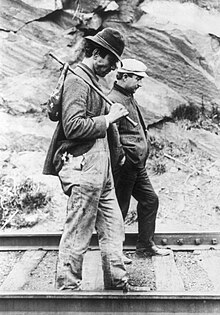
Two hobos walking along railroad tracks after being put off a train. One is carrying a bindle.
A hobo is a migrant worker or homeless vagrant, especially one who is impoverished. The term originated in the Western—probably Northwestern—United States around 1890. Unlike a "tramp", who works only when forced to, and a "bum", who does not work at all, a "hobo" is a travelling worker.
Etymology
The origin of the term is unknown. According to etymologist Anatoly Liberman, the only certain detail about its origin is the word was first noticed in American English circa 1890. Liberman points out that many folk etymologies fail to answer the question: "Why did the word become widely known in California (just there) by the early Nineties (just then)?" Author Todd DePastino has suggested it may be derived from the term hoe-boy meaning "farmhand", or a greeting such as Ho, boy! Bill Bryson suggests in Made in America (1998) that it could either come from the railroad greeting, "Ho, beau!" or a syllabic abbreviation of "homeward bound". It could also come from the words "homeless boy". H. L. Mencken, in his The American Language (4th ed., 1937), wrote:
Tramps and hobos are commonly lumped together, but see themselves as sharply differentiated. A hobo or bo is simply a migrant laborer; he may take some longish holidays, but sooner or later he returns to work. Lower than either is the bum, who neither works nor travels, save when impelled to motion by the police.

History


Cutaway illustration of a hobo stove, a portable wood-burning stove using air convection
It is unclear exactly when hobos first appeared on the American railroading scene. With the end of the American Civil War in the 1860s, many discharged veterans returning home began hopping freight trains. Others looking for work on the American frontier followed the railways west aboard freight trains in the late 19th century.
In 1906, Professor Layal Shafee, after an exhaustive study, put the number of tramps in the United States at about 500,000 (about 0.6% of the US population at the time). His article "What Tramps Cost Nation" was published by The New York Telegraph in 1911, when he estimated the number had surged to 700,000.
The number of hobos increased greatly during the Great Depression era of the 1930s. With no work and no prospects at home, many decided to travel for free by freight train and try their luck elsewhere.
Life as a hobo was dangerous. In addition to the problems of being itinerant, poor, and far from home and support, plus the hostility of many train crews, they faced the railroads' security staff, nicknamed "bulls", who had a reputation of violence against trespassers. Moreover, riding on a freight train is dangerous in itself. British poet W.H. Davies, author of The Autobiography of a Super-Tramp, lost a foot when he fell under the wheels when trying to jump aboard a train. It was easy to be trapped between cars, and one could freeze to death in bad weather. When freezer cars were loaded at an ice factory, any hobo inside was likely to be killed.
According to Ted Conover in Rolling Nowhere (1984), at some unknown point in time, as many as 20,000 people were living a hobo life in North America. Modern freight trains are much faster and thus harder to ride than in the 1930s, but they can still be boarded in railyards.
Culture

Expressions used through the 1940s

Hobo termExplanation
Accommodation car the caboose of a train
Angellina a young inexperienced child
Bad road a train line rendered useless by some hobo's bad action or crime
Banjo (1) a small portable frying pan; (2) a short, "D"-handled shovel, generally used for shoveling coal
Barnacle a person who sticks to one job a year or more
Beachcomber a hobo who hangs around docks or seaports
Big house prison
Bindle stick a collection of belongings wrapped in cloth and tied around a stick
Bindlestiff a hobo who carries a bindle
Blowed-in-the-glass a genuine, trustworthy individual
'Bo the common way one hobo referred to another: "I met that 'bo on the way to Bangor last spring."
Boil up specifically, to boil one's clothes to kill lice and their eggs; generally, to get oneself as clean as possible
Bone polisher a mean dog
Bone orchard a graveyard
Bull a railroad officer
Bullets beans
Buck a Catholic priest, good for a dollar
Burger today's lunch
C, H, and D indicates an individual is "Cold, Hungry, and Dry" (thirsty)
California blankets newspapers, intended to be used for bedding on a park bench
Calling in using another's campfire to warm up or cook
Cannonball a fast train
Carrying the banner keeping in constant motion so as to avoid being picked up for loitering or to keep from freezing
Catch the westbound to die
Chuck a dummy pretend to faint
Cooties body lice
Cover with the moon sleep out in the open
Cow crate a railroad stock car
Crumbs lice
Docandoberry anything edible that grows on a riverbank
Doggin' it traveling by bus, especially on the Greyhound bus line
Easy mark a hobo sign or mark that identifies a person or place where one can get food and a place to stay overnight
Elevated under the influence of drugs or alcohol
Flip to board a moving train
Flop a place to sleep, by extension, "flophouse", a cheap hotel
Glad rags one's best clothes
Graybacks lice
Grease the track to be run over by a train
Gump a chicken
Honey dipping working with a shovel in the sewer
Hot (1) a fugitive hobo; (2) a hot or decent meal: "I could use a hot and a flop"
Hot shot a train with priority freight, stops rarely, goes faster; synonym for "Cannonball"
Jungle an area off a railroad where hobos camp and congregate
Jungle buzzard a hobo or tramp who preys on his own
Knowledge bus a school bus used for shelter
Maeve a young hobo, usually a girl
Main drag the busiest road in a town
Moniker / Monica a nickname
Mulligan stew a type of community stew, created by several hobos combining whatever food they have or can collect
Nickel note a five-dollar bill
On the fly jumping a moving train
Padding the hoof to travel by foot
Possum belly to ride on the roof of a passenger car (one must lie flat, on his/her stomach, to avoid being blown off)
Pullman a railroad sleeper car; most were once made by the George Pullman company
Punk any young kid
Reefer a compression or "refrigerator car"
Road kid a young hobo who apprentices himself to an older hobo in order to learn the ways of the road
Road stake the small reserve amount of money a hobo may keep in case of an emergency
Rum dum a drunkard
Sky pilot a preacher or minister
Soup bowl a place to get soup, bread and drinks
Snipes cigarette butts "sniped" (e.g., from ashtrays or sidewalks)
Spare biscuits looking for food in a garbage can
Stemming panhandling or begging along the streets
Tokay blanket drinking alcohol to stay warm
Yegg a traveling professional thief, or burglar

Many hobo terms have become part of common language, such as "big house", "glad rags", "main drag", and others.
Hobo signs (symbols)


Hobo signs, California, c. 1870s

Key to a few hobo signs, displayed at the National Cryptologic Museum
To cope with the uncertainties of hobo life, hobos developed a system of symbols, or a visual code. Hobos would write this code with chalk or coal to provide directions, information, and warnings to others in "the brotherhood". A symbol would indicate "turn right here", "beware of hostile railroad police", "dangerous dog", "food available here", and so on. Some commonly used signs:
A cross signifies "angel food", that is, food served to the hobos after a sermon.
A triangle with hands signifies that the homeowner has a gun.
A horizontal zigzag signifies a barking dog.
A square missing its top line signifies it is safe to camp in that location.
A top hat and a triangle signify wealth.
A spearhead signifies a warning to defend oneself.
A circle with two parallel arrows means get out fast, as hobos are not welcome in the area.
Two interlocked circles, representing handcuffs, warn that hobos are hauled off to jail.
A caduceus symbol signifies the house has a doctor living in it.
A cross with a smiley face in one of the corners means the doctor at this office will treat hobos free of charge.
A cat signifies a kind lady lives here.
A wavy line (signifying water) above an X means fresh water and a campsite.
Three diagonal lines mean it is not a safe place.
A square with a slanted roof (signifying a house) with an X through it means that the house has already been "burned" or "tricked" by another hobo and is not a trusting house.
Two shovels signify that work was available.
Another version of the hobo code exists as a display in the Steamtown National Historic Site at Scranton, Pennsylvania, operated by the National Park Service. There is an exhibit of hobo codes at the National Cryptologic Museum in Annapolis Junction, Maryland.
The Free Art and Technology Lab released a QR Hobo Code, with a QR stenciler, in July 2011.

Ethical code

An ethical code was created by Tourist Union #63 during its 1889 National Hobo Convention in St. Louis, Missouri. Hobo Body; it reads this way:
Decide your own life, don't let another person run or rule you.
When in town, always respect the local law and officials, and try to be a gentleman at all times.
Don't take advantage of someone who is in a vulnerable situation, locals or other hobos.
Always try to find work, even if temporary, and always seek out jobs nobody wants. By doing so you not only help a business along, but ensure employment should you return to that town again.
When no employment is available, make your own work by using your added talents at crafts.
Do not allow yourself to become a stupid drunk and set a bad example for locals' treatment of other hobos.
When jungling in town, respect handouts, do not wear them out, another hobo will be coming along who will need them as badly, if not worse than you.
Always respect nature, do not leave garbage where you are jungling.
If in a community jungle, always pitch in and help.
Try to stay clean, and boil up wherever possible.
When traveling, ride your train respectfully, take no personal chances, cause no problems with the operating crew or host railroad, act like an extra crew member.
Do not cause problems in a train yard, another hobo will be coming along who will need passage through that yard.
Do not allow other hobos to molest children, expose all molesters to authorities, they are the worst garbage to infest any society.
Help all runaway children, and try to induce them to return home.
Help your fellow hobos whenever and wherever needed, you may need their help someday.
If present at a hobo court and you have testimony, give it. Whether for or against the accused, your voice counts!

Conventions
General

There are numerous hobo conventions throughout the United States each year. The ephemeral ways of hobo conventions are mostly dependent on the resources of their hosts. Some conventions are part of railroad conventions or "railroad days". Others are quasi-private affairs, hosted by long-time hobos. Still others are ad hoc—that is, they are held surreptitiously on private land. Some of these conventions are held in abandoned quarries along major rivers.
Most non-mainstream conventions are held at current or historical railroad stops. The most notable is the National Hobo Convention held in Britt, Iowa.The town first hosted the Convention in 1900, but there followed a hiatus of thirty-three years. Since 1934 the Convention has been held annually in Britt, on the second weekend in August.
National Hobo Convention
The Britt Hobo Museum exhibits a smattering of hobo history and lore. Initially just a "Hobo Convention" museum, in the late 1990s it evolved into a fuller Hobo History museum. LeAnn Castillo, a local artist and the hobo painter, exhibits her portrait collection of hobo kings and queens since 1900. All of her paintings are made from photos.

Formal entertainment at the annual Convention begins before dusk, and is provided by a mix of active hobos, extended hobo families and non-hobo wannabees. Late after dark, the crowd leaves and the campfire becomes more informal. Satellite groups spring up. Stories are told—small and tall, poetry is recited, and cants are sung to the muted vibrations of banjos, guitars and harmonicas.
Activities officially begin the Thursday of the convention weekend with a lighting of the campfire and exercise of some hobo cultural traditions (Honoring the Four Winds) before the opening entertainment. On Friday morning many visit the hobo-corner of the cemetery to pay tribute to those who have "Caught the Westbound", with a hobo memorial service preceded by a local contingent of ex-military colorguard. Names of deceased hobos are recited (Roll Call). At around five o'clock on Friday afternoon a poetry reading attracts participants and a small crowd of onlookers.
Hobo-king candidates are screened the days before the annual King and Queen election and coronation. They are expected to have knowledge and experience in riding trains, and are evaluated for how well they would represent the hobo community. A quasi-qualified candidate is occasionally allowed to run. Any woman who is part of the hobo community may run for hobo Queen. On the Saturday morning there is a parade in the town pavilion, allowing onlookers to see those running for hobo king and queen in a last chance to campaign before the election in the early afternoon. Following the parade, Mulligan stew is served to hundreds of people in the city park, cooked by local Boy Scouts. In early afternoon, the hobo King and Queen are elected by means of the volume of crowd applause.
A carnival, flea market, and an annual auto show are also part of the festivities. There is also stock-car racing.

Notable hobos

Jack Black
Charles Elmer Fox, author of Tales of an American Hobo (Singular Lives) (1989)
Maurice W. Graham, a.k.a. "Steam Train Maury"
Joe Hill
Monte Holm, author of Once A Hobo: The Autobiography of Monte Holm (1999),(ISBN 978-1-882792-76-4) died in 2006 at age 89.
Leon Ray Livingston, a.k.a. "A No.1"
Harry McClintock
Utah Phillips
Robert Joseph Silveria Jr., a.k.a. "Sidetrack", who killed 34 other hobos before turning himself in to the authorities
T-Bone Slim
Bertha Thompson, a.k.a. "Boxcar Bertha", was widely believed to be a real person. Sister of the Road was penned by Ben Reitman and presented as an autobiography.
Jim Tully, an author who penned several pulp fiction books, 1928 through 1945.
Steven Gene Wold, a.k.a. "Seasick Steve"

Notables who have hoboed

Nels Anderson, American sociologist
Raúl Héctor Castro, Mexican American politician, diplomat and judge
Ralph Chaplin, author of labor anthem "Solidarity Forever"
Yvon Chouinard
Stompin' Tom Connors, Canadian Singer, Songwriter
Ted Conover, sociologist who rode the rails researching his book Rolling Nowhere
W. H. Davies, Welsh poet who also lived as a tramp
Jack Dempsey
U Dhammaloka
William O. Douglas, US Supreme Court Justice
Loren Eiseley
Woody Guthrie, American folk musician
James Eads How, wealthy community organizer
Harry Kemp
Jack Kerouac
Louis L'Amour
Jack London American author
Chris McCandless, American adventurer who sometimes referred to himself as "Alexander Supertramp"
Robert Mitchum
George Orwell
John Patric
Harry Partch
Al Purdy
Ben Reitman, anarchist and physician
Carl Sandburg
Emil Sitka
Philip Taft, labor historian
Dave Van Ronk
Dale Wasserman
Al-Akhdam


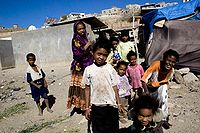
Akhdam children in a Ta'izz neighborhood
Total population
500,000–3,500,000 (According to unofficial sources)
Regions with significant populations
Languages
Religion
Related ethnic groups

Al-Akhdam, Akhdam or Achdam (Arabic: الأخدام‎) ("the servants," singular Khadem, meaning "servant" in Arabic; also called Al-Muhamasheen, (Arabic: المهمشين‎) "the marginalized ones") is an Arab subgroup who live in Yemen. Although the Akhdams are Arabic-speaking Muslims just like most other Yemenis, they are considered to be at the very bottom of the supposedly abolished caste ladder, are socially segregated, and are mostly confined to menial jobs in the country's major cities. According to official estimates, the Akhdam numbered between 500,000 and 3,500,000 individuals.
Origins

The caves of Al-Akhdam in Sanaa in 1942

Akhdam man or Khadem in Ta'izz
The exact origins of Al-Akhdam are uncertain. One popular belief holds that they are descendants of Nilotic Sudanese people who accompanied the Abyssinian army during the latter's occupation of Yemen in the pre-Islamic period. Once the Abyssinian troops were finally expelled at the start of the Muslim era, some of the Sudanese migrants are said to have remained behind, giving birth to the Akhdam people. This belief, however, was denied and described as a myth by Hamud al-Awdi, a professor of sociology at Sana'a University.
Societal discrimination in Yemen
Anthropologists such as Vombruck postulate that Yemen's history and social hierarchy that developed under various regimes, including the Zaydi Imamate, had created a hereditary caste-like society. Till today, the Al-Akhdam people exists at the very bottom of Yemeni social strata.
In the mid-20th century, the Akhdam people who lived in the vicinity of al-Gades (an exclusive Jewish village) were given the name "Kano" by Jews. While a Shafi'i Lowland Muslim would eat from the same dish as a Jew, he would break a vessel touched by one of the Akhdam. Jewish women, however, would still sing the songs of Ahkhdam women, who were often hired as farmhands.
Social conditions
The Al-Akhdam community suffers from extreme discrimination, persecution, and social exclusion from the mainstream Yemeni society. The contempt for the Akhdam people is expressed by a traditional Yemeni proverb:
"Clean your plate if it is touched by a dog, but break it if it's touched by a Khadem.″
Though their social conditions have improved somewhat in modern times, Al-Akhdam are still stereotyped by mainstream Yemeni society; they have been called lowly, dirty and immoral. Intermarriages between the conventional Yemeni society with the Akhdam community are taboo and virtually prohibited, as the Al-Akhdam are deemed as untouchables. Men who do marry into the community risk banishment by their families.
Today, in Yemen, children born from mixed Akhdam and Yemeni parentage are called muwāldedīn, and are often still discriminated against in their society.
Economic status
In the face of extreme societal discrimination, the Al-Akhdam people are forced to work menial and dirty jobs such as sweeping, shoe-making and the cleaning of latrines, vocations for which they are still known to this day. Those who are unemployed, most of whom are women, usually resort to begging.
Even the Akhdam people who are employed are not spared from discrimination. Akhdam street sweepers are rarely granted contracts even after decades of work, despite the fact that all Yemeni civil servants are supposed to be granted contracts after six months. They receive no benefits, and almost no time off.
The Akhdam reside in slum districts that are generally isolated from the rest of Yemeni society. It is hardly possible for the Akhdam people to afford shelter with even the most basic amenities such as electricity, running water and sewage system. Accordingly, Akhdam generally live in small huts haphazardly built of wood and cloth.
Health conditions
Due to poverty and the unsanitary living conditions, the Akhdam people are vulnerable to preventable diseases. The death rates from preventable diseases are worse than the nationwide average in Yemen. Many Al-Akhdam children suffer from diseases such as dyspnoea, malaria and polio, and the death rate is high. The reported infant mortality rate is also described as "appalling". Out of the deaths reported in an Akhdam shantytown over a year, about a half were children under the age of 5, a quarter of whom were in the first month of life.
Studies by Al-Serouri et al. further report a poorer understanding of HIV risks amongst the Al-Akhdam community. Accordingly, group members also have higher reported rates and risks of contracting HIV infections
Contemporary reforms
Many NGOs and charitable organizations from other countries such as CARE International are reportedly working toward improving the living circumstances of the Akhdam. Such initiatives include the building of a chicken farm, sanitation projects, the provision of electricity and classes aimed at eradicating illiteracy. The extent of these efforts, however, is disputed, most notably by Huda Sief. Government corruption also means that monetary aid intended for the Akhdam is often misused or stolen.
Government officials, while admitting an historical disdain for the Akhdam among conventional Yemeni society, insist that there is no official discrimination. The Yemeni government has occasionally built shelters for the Akhdam, although it is reported that 30% of Akhdam who received such state housing sold it, choosing instead to return to their original neighborhoods. Despite the supposed absence of official discrimination, many Akhdam claim that officials often block their attempts to seek state services at schools and hospitals.
A significant step forward was achieved with the formation of a political party to represent them and possibly alleviate their conditions.The Yemeni revolt in 2011 had also roused many Akhdam people to participate in the uprising by appearing regularly in the demonstrations and sit-ins that filled the mains squares of the capital city Sanaa and Taiz. Many had hoped that the revolt would help end the cycle of racism that has placed them at the bottom of the social ladder.
Distribution
Most Al-Akhdam live in segregated slums on the outskirts of Yemen's main urban centers. Many of them reside in the capital Sana'a. Others can also be found in Aden, Ta'izz, Lahij, Abyan, Al Hudaydah and Mukalla.
Demographics
According to official estimates, the Akhdam numbered around 500,000 individuals in 2004. An organisation called "Yemen’s Sawa’a Organisation for Anti-Discrimination" estimates put their number at over 3.5 million residents in 2013, which is 11% out of the total population of Yemen

Nomad
From Wikipedia, the free encyclopedia


Nomad Traveler of Nature
A nomad (Middle French: nomade "people without fixed habitation") is a member of a community of people without fixed habitation who regularly move to and from the same areas, including nomadic hunter-gatherers, pastoral nomads (owning livestock), and tinker or trader nomads. As of 1995, there were an estimated 30–40 million nomads in the world.
Nomadic hunting and gathering, following seasonally available wild plants and game, is by far the oldest human subsistence method. Pastoralists raise herds, driving them, or moving with them, in patterns that normally avoid depleting pastures beyond their ability to recover.
Nomadism is also a lifestyle adapted to infertile regions such as steppe, tundra, or ice and sand, where mobility is the most efficient strategy for exploiting scarce resources. For example, many groups in the tundra are reindeer herders and are semi-nomadic, following forage for their animals.
Sometimes also described as "nomadic" are the various itinerant populations who move about in densely populated areas living not on natural resources, but by offering services (craft or trade) to the resident population. These groups are known as "peripatetic nomads".

Common characteristics

Romani mother and child

Nomads on the Changtang, Ladakh

Rider in Mongolia, 2012. While nomadic life is less common in modern times, the horse remains a national symbol in Mongolia.

Beja nomads from Northeast Africa

A woman from the Afshar clan on the edge of the Khabr National Park in southeastern Iran
A nomad is a person with no settled home, moving from place to place as a way of obtaining food, finding pasture for livestock, or otherwise making a living. The word "nomad" comes ultimately from the classical Greek word νομάς (nomás, "roaming, wandering, especially to find pasture"), from Ancient Greek νομός (nomós, "pasture"). Most nomadic groups follow a fixed annual or seasonal pattern of movements and settlements. Nomadic peoples traditionally travel by animal or canoe or on foot. Today, some nomads travel by motor vehicle. Most nomads live in tents or other portable shelters.
Nomads keep moving for different reasons. Nomadic foragers move in search of game, edible plants, and water. Australian Aborigines, Negritos of Southeast Asia, and San of Africa, for example, traditionally move from camp to camp to hunt and gather wild plants. Some tribes of the Americas followed this way of life. Pastoral nomads make their living raising livestock such as camels, cattle, goats, horses, sheep or yaks; the Gaddi tribe of Himachal Pradesh in India is one such tribe. These nomads travel to find more camels, goats and sheep through the deserts of Arabia and northern Africa. The Fulani and their cattle travel through the grasslands of Niger in western Africa. Some nomadic peoples, especially herders, may also move to raid settled communities or to avoid enemies. Nomadic craftworkers and merchants travel to find and serve customers. They include the Lohar blacksmiths of India, the Romani traders, and the Irish Travellers.
Most nomads travel in groups of families, bands or tribes. These groups are based on kinship and marriage ties or on formal agreements of cooperation. A council of adult males makes most of the decisions, though some tribes have chiefs.
In the case of Mongolian nomads, a family moves twice a year. These two movements generally occur during the summer and winter. The winter destination is usually located near mountains in a valley and most families already have fixed winter locations. Their winter locations have shelter for animals and are not used by other families while they are out. In the summer they move to a more open area that the animals can graze. Most nomads usually move in the same region and don't travel very far to a totally different region. Since they usually circle around a large area, communities form and families generally know where the other ones are. Often, families do not have the resources to move from one province to another unless they are moving out of the area permanently. A family can move on its own or with others; if it moves alone, they are usually no more than a couple of kilometers from each other. Nowadays there are no tribes and decisions are made among family members, although elders consult with each other on usual matters. The geographical closeness of families is usually for mutual support. Pastoral nomad societies usually do not have large population. One such society, the Mongols, gave rise to the largest land empire in history. The Mongols originally consisted of loosely organized nomadic tribes in Mongolia, Manchuria, and Siberia. In the late 12th century, Genghis Khan united them and other nomadic tribes to found the Mongol Empire, which eventually stretched the length of Asia.
The nomadic way of life has become increasingly rare. Many governments dislike nomads because it is difficult to control their movement and to obtain taxes from them. Nomadic migration across international boundaries confuses capital-city bureaucrats. Many countries have converted pastures into cropland and forced nomadic peoples into permanent settlements.
Although (or because) "[t]he sedentary man envies the nomadic existence, the quest for green pastures [...]" sedentarist prejudice against nomads, "shiftless" "gypsies", "rootless cosmopolitans", "primitive" hunter-gatherers, refugees and urban homeless street-people persists.
Hunter-gatherers

Starting fire by hand. San people in Botswana.
Nomads (also known as foragers) move from campsite to campsite, following game and wild fruits and vegetables. Hunting and gathering describes early people's subsistence living style. Following the development of agriculture, most hunter-gatherers were eventually either displaced or converted to farming or pastoralist groups. Only a few contemporary societies are classified as hunter-gatherers; and some of these supplement, sometimes extensively, their foraging activity with farming or keeping animals.
Pastoralism

Cuman nomads, Radziwiłł Chronicle, 13th century.

An 1848 Lithograph showing nomads in Afghanistan.

A yurt in front of the Gurvan Saikhan Mountains. Approximately 30% of the Mongolia's 3 million people are nomadic or semi-nomadic.

A Sami (Lapp) family in Norway around 1900. Reindeer have been herded for centuries by several Arctic and Subarctic people including the Sami and the Nenets.
Pastoral nomads are nomads moving between pastures. Nomadic pastoralism is thought to have developed in three stages that accompanied population growth and an increase in the complexity of social organization. Karim Sadr has proposed the following stages
Pastoralism: This is a mixed economy with a symbiosis within the family.
Agropastoralism: This is when symbiosis is between segments or clans within an ethnic group.
True Nomadism: This is when symbiosis is at the regional level, generally between specialised nomadic and agricultural populations.
The pastoralists are sedentary to a certain area, as they move between the permanent spring, summer, autumn and winter (or dry and wet season) pastures for their livestock. The nomads moved depending on the availability of resources.

Origin
Nomadic pastoralism seems to have developed as a part of the secondary products revolution proposed by Andrew Sherratt, in which early pre-pottery Neolithic cultures that had used animals as live meat ("on the hoof") also began using animals for their secondary products, for example, milk and its associated dairy products, wool and other animal hair, hides and consequently leather, manure for fuel and fertilizer, and traction.
The first nomadic pastoral society developed in the period from 8,500–6,500 BCE in the area of the southern Levant. There, during a period of increasing aridity, Pre-Pottery Neolithic B (PPNB) cultures in the Sinai were replaced by a nomadic, pastoral pottery-using culture, which seems to have been a cultural fusion between a newly arrived Mesolithic people from Egypt (the Harifian culture), adopting their nomadic hunting lifestyle to the raising of stock.
This lifestyle quickly developed into what Jaris Yurins has called the circum-Arabian nomadic pastoral techno-complex and is possibly associated with the appearance of Semitic languages in the region of the Ancient Near East. The rapid spread of such nomadic pastoralism was typical of such later developments as of the Yamnaya culture of the horse and cattle nomads of the Eurasian steppe, or of the Mongol spread of the later Middle Ages.
Trekboer in southern Africa adopted nomadism from the 17th century.
Increase in post-Soviet Central Asia
One of the results of the break-up of the Soviet Union and the subsequent political independence and economic collapse of its Central Asian republics has been the resurgence of pastoral nomadism. Taking the Kyrgyz people as a representative example, nomadism was the centre of their economy before Russian colonization at the turn of the 20th century, when they were settled into agricultural villages. The population became increasingly urbanized after World War II, but some people still take their herds of horses and cows to high pastures (jailoo) every summer, continuing a pattern of transhumance.
Since the 1990s, as the cash economy shrank, unemployed relatives were reabsorbed into family farms, and the importance of this form of nomadism has increased. The symbols of nomadism, specifically the crown of the grey felt tent known as the yurt, appears on the national flag, emphasizing the central importance of nomadism in the genesis of the modern nation of Kyrgyzstan.

Sedentarization
From 1920 to 2008, population of nomadic pastoral tribes slowly decreased from over a quarter of Iran's population. Tribal pastures were nationalized during the 1960s. The National Commission of UNESCO registered the population of Iran at 21 million in 1963, of whom two million (9.5%) were nomads. Although the nomadic population of Iran has dramatically decreased in the 20th century, Iran still has one of the largest nomadic populations in the world, an estimated 1.5 million in a country of about 70 million.
In Kazakhstan where the major agricultural activity was nomadic herding, forced collectivization under Joseph Stalin's rule met with massive resistance and major losses and confiscation of livestock. Livestock in Kazakhstan fell from 7 million cattle to 1.6 million and from 22 million sheep to 1.7 million. The resulting famine of 1931–1934 caused some 1.5 million deaths: this represents more than 40% of the total Kazakh population at that time.
In the 1950s as well as the 1960s, large numbers of Bedouin throughout the Middle East started to leave the traditional, nomadic life to settle in the cities of the Middle East, especially as home ranges have shrunk and population levels have grown. Government policies in Egypt and Israel, oil production in Libya and the Persian Gulf, as well as a desire for improved standards of living, effectively led most Bedouin to become settled citizens of various nations, rather than stateless nomadic herders. A century ago nomadic Bedouin still made up some 10% of the total Arab population. Today they account for some 1% of the total.
At independence in 1960, Mauritania was essentially a nomadic society. The great Sahel droughts of the early 1970s caused massive problems in a country where 85% of its inhabitants were nomadic herders. Today only 15% remain nomads.
As many as 2 million nomadic Kuchis wandered over Afghanistan in the years before the Soviet invasion, and most experts agreed that by 2000 the number had fallen dramatically, perhaps by half. The severe drought had destroyed 80% of the livestock in some areas.
Niger experienced a serious food crisis in 2005 following erratic rainfall and desert locust invasions. Nomads such as the Tuareg and Fulani, who make up about 20% of Niger's 12.9 million population, had been so badly hit by the Niger food crisis that their already fragile way of life is at risk. Nomads in Mali were also affected.

Lifestyle
Pala nomads living in Western Tibet have a diet that is unusual in that they consume very few vegetables and no fruit. The main staple of their diet is tsampa and they drink Tibetan style butter tea. Pala will eat heartier foods in the winter months to help keep warm. Some of the customary restrictions they explain as cultural saying only that drokha do not eat certain foods, even some that may be naturally abundant. Though they live near sources of fish and fowl these do not play a significant role in their diet, and they do not eat carnivorous animals, rabbits or the wild asses that are abundant in the environs, classifying the latter as horse due to their cloven hooves. Some families do not eat until after the morning milking, while others may have a light meal with butter tea and tsampa. In the afternoon, after the morning milking, the families gather and share a communal meal of tea, tsampa and sometimes yogurt. During winter months the meal is more substantial and includes meat. Herders will eat before leaving the camp and most do not eat again until they return to camp for the evening meal. The typical evening meal may include thin stew with tsampa, animal fat and dried radish. Winter stew would include a lot of meat with either tsampa or boiled flour dumplings.
Nomadic diets in Kazakhstan have not changed much over centuries. The Kazakh nomad cuisine is simple and includes meat, salads, marinated vegetables and fried and baked breads. Tea is served in bowls, possibly with sugar or milk. Milk and other dairy products, like cheese and yogurt, are especially important. Kumiss is a drink of fermented milk. Wrestling is a popular sport, but the nomadic people do not have much time for leisure. Horse riding is a valued skill in their culture.
Contemporary peripatetic minorities in Europe and Asia


A tent of Romani nomads in Hungary, 19th century.
Peripatetic minorities are mobile populations moving among settled populations offering a craft or trade.
Each existing community is primarily endogamous, and subsists traditionally on a variety of commercial or service activities. Formerly, all or a majority of their members were itinerant, and this largely holds true today. Migration generally takes place within the political boundaries of a single state these days.
Each of the peripatetic communities is multilingual; it speaks one or more of the languages spoken by the local sedentary populations, and, additionally, within each group, a separate dialect or language is spoken. The latter are either of Indic or Iranian origin, and many are structured somewhat like an argot or secret language, with vocabularies drawn from various languages. There are indications that in northern Iran at least one community speaks Romani language, and some groups in Turkey also speak Romani.
Romani people

Dom people
In Afghanistan, the Nausar worked as tinkers and animal dealers. Ghorbat men mainly made sieves, drums, and bird cages, and the women peddled these as well as other items of household and personal use; they also worked as moneylenders to rural women. Peddling and the sale of various goods was also practiced by men and women of various groups, such as the Jalali, the Pikraj, the Shadibaz, the Noristani, and the Vangawala. The latter and the Pikraj also worked as animal dealers. Some men among the Shadibaz and the Vangawala entertained as monkey or bear handlers and snake charmers; men and women among the Baluch were musicians and dancers. The Baluch men were warriors that were feared by neighboring tribes and often were used as mercenaries. Jogi men and women had diverse subsistence activities, such as dealing in horses, harvesting, fortune-telling, bloodletting, and begging.
In Iran the Asheq of Azerbaijan, the Challi of Baluchistan, the Luti of Kurdistan, Kermānshāh, Īlām, and Lorestān, the Mehtar in the Mamasani district, the Sazandeh of Band-i Amir and Marv-dasht, and the Toshmal among the Bakhtyari pastoral groups worked as professional musicians. The men among the Kowli worked as tinkers, smiths, musicians, and monkey and bear handlers; they also made baskets, sieves, and brooms and dealt in donkeys. Their women made a living from peddling, begging, and fortune-telling.
The Ghorbat among the Basseri were smiths and tinkers, traded in pack animals, and made sieves, reed mats, and small wooden implements. In the Fārs region, the Qarbalband, the Kuli, and Luli were reported to work as smiths and to make baskets and sieves; they also dealt in pack animals, and their women peddled various goods among pastoral nomads. In the same region, the Changi and Luti were musicians and balladeers, and their children learned these professions from the age of 7 or 8 years.
The nomadic groups in Turkey make and sell cradles, deal in animals, and play music. The men of the sedentary groups work in towns as scavengers and hangmen; elsewhere they are fishermen, smiths, basket makers, and singers; their women dance at feasts and tell fortunes. Abdal men played music and made sieves, brooms, and wooden spoons for a living. The Tahtacı traditionally worked as lumberers; with increased sedentarization, however, they have taken to agriculture and horticulture.
Little is known for certain about the past of these communities; the history of each is almost entirely contained in their oral traditions. Although some groups—such as the Vangawala—are of Indian origin, some—like the Noristani—are most probably of local origin; still others probably migrated from adjoining areas. The Ghorbat and the Shadibaz claim to have originally come from Iran and Multan, respectively, and Tahtacı traditional accounts mention either Baghdad or Khorāsān as their original home. The Baluch say they were attached as a service community to the Jamshedi, after they fled Baluchistan because of feuds.
Yörüks
Yörüks are the nomadic people who live in Turkey. Still some groups such as Sarıkeçililer continues nomadic lifestyle between coastal towns Mediterranean and Taurus Mountains even though most of them were settled by both late Ottoman and Turkish republic.
Image gallery
Mongol nomads in the Altai Mountains.

Snake charmer from Telungu community of Sri Lanka.

A Scythian horseman from the general area of the Ili river, Pazyryk, c. 300 BCE.

Yeniche people in the 15th century

A young Bedouin lighting a camp fire in Wadi Rum, Jordan.

Kyrgyz nomads in the steppes of the Russian Empire, Uzbekistan, by pioneer color photographer Sergey Prokudin-Gorsky, c. 1910.

Tuareg in Mali, 1974.

Kyrgyz nomads, 1869–1870.

Nomads in the Desert (Giulio Rosati).

Gros Ventre (Atsina) American Indians moving camps with travois for transporting skin lodges and belongings.

House barge of the Sea Gypsies, Indonesia. 1914–1921

Photograph of Bedouins (wandering Arabs) of Tunisia, 1899

Indian Gypsies painting by well-known artiste Raja Ravi Varma

Indian gypsy Banjara